
Transit Network Design Course
- “Awesome! Clear and challenging!”
- “Excellent instructor. A lot of information with a high degree of clarity.”
- “The best workshop I’ve ever been in.”
- “Inexcusably fun!”
JWA offers intensive courses in public transit network design, designed to help many kinds of professionals and advocates better incorporate transit into their work. Our most popular is a two-day intensive course, but we can also do longer or shorter versions on request.
-> NEW 2026 SESSION OF OUR 2-DAY INTENSIVE COURSE, IN CHICAGO! DETAILS HERE.
Subscribe here for course updates!
Who’s it For?
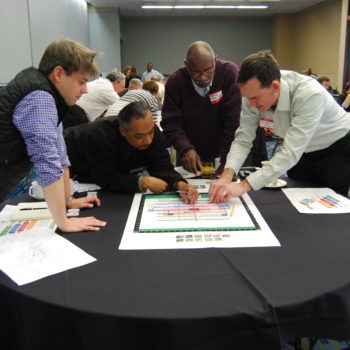
Our Transit Network Design Course gives people a grasp of how transit networks and services work, so that they can form more confident and resilient opinions about transit proposals in their own work.
The course is ideal for people who interact with transit planning in their work but don’t necessarily do it themselves — including land use planners, urban designers, developers, traffic engineers, sustainability advocates, Board members, transit employees of all kinds, and people who work on transportation or urban policy generally. Advocates who want to be more realistic and effective will also find the course valuable, especially as a companion to Jarrett’s book Human Transit.
This course fills a critical gap in many people’s professional training. It offers a fun, hands-on way of learning what makes an effective transit network, and what those insights mean for all the related professions.
How Does it Work?
A critical piece is missing the training of most people in the city-building professionals. Few people get hands-on experience working with transit as a tool, understanding how to use this tool to build a transit network. Learning to think creatively with these tools is the essence of transit planning, and of transit-related planning of anything else. If you’re going to interact with transit in any way — as a planner, a developer, an advocate, an elected official — you’ll make better decisions if you’ve played with network design a little, so that you have a feel for how the transit tool works. This course is designed to give you exactly that taste.
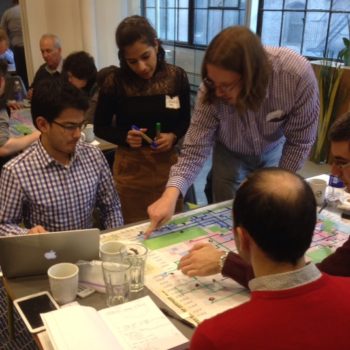 We believe in teaching transit planning the way you’d teach carpentry. A good carpentry class might involve a lecture about the structure of wood and how to not kill yourself with a saw, but after that, you’ll only learn carpentry by doing it.
The course is a built around a series of exercises where students work together to design transit networks for a fictional city, based on its geography and a set of cost limitations. The exercises let students learn the basic tools and materials by actually working with them to develop creative solutions to a series of planning problems. You’ll remember what you learn in this course because you’ll have discovered it yourself, and formed your own insights about it.
The two-day course covers:
- The basic tools: line, frequency, span, etc.
- Clarifying goals.
- Principles of good network structure.
- Network design techniques.
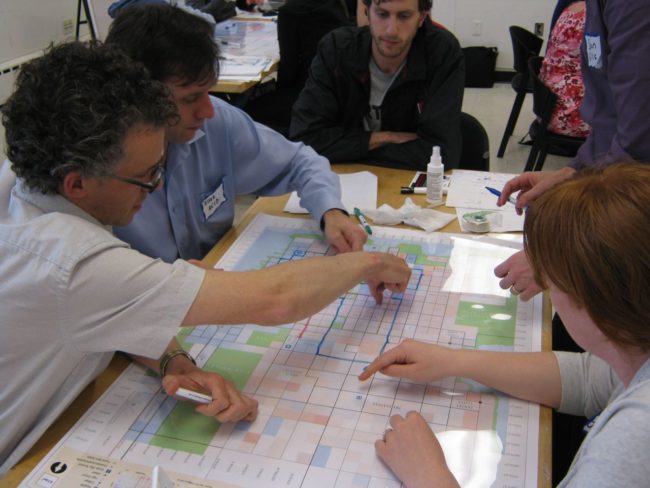
- Network evaluation, including access analysis.
- Interaction of public transit and urban form.
- Fixed vs flexible transit.
- Role of fixed guideways in transit networks.
We can also do longer versions of the course, including more on:
- Guiding public conversations around network design.
- More advanced evaluation techniques.
- Integrating transit planning with key development policy issues: urban form, housing policy, parking policy, traffic engineering standards.
- Integrating transit and micromobility, including cycling, scooters etc.
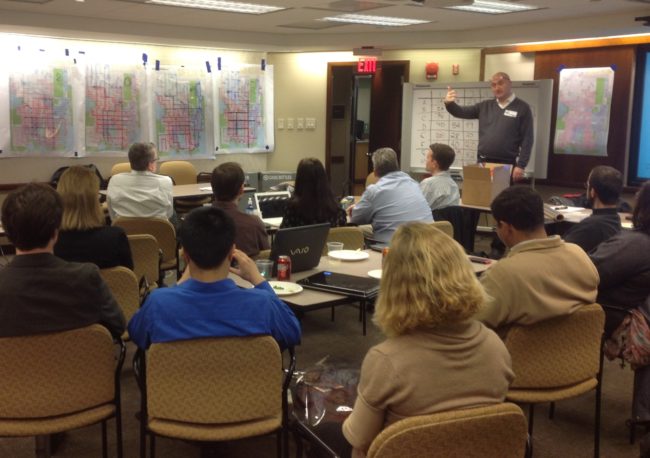
The course is done in intensive format covering one or two consecutive days. About 70% of class time is in fun, interactive exercises, while most of the rest consists of group discussion based on the results of the interactive work.
What Graduates Have Said
“Jarrett Walker’s two day transit network design class explores the intricacy of designing transit networks, touching on elements ranging from maximizing the utility of a strained, underfunded bus system to planning high capacity bus and rail lines. This is the kind of modern design that transit agencies should be using to attract new ridership.” – Mike Cechvala, City of Madison, Wisconsin
“One of the most useful and practical transit planning courses I’ve come across, and thoroughly enjoyable too.” – Stuart Johns, Queensland Dept. of Transport and Main Roads (Australia)
The course consistently receives very positive reviews from student evaluations.
How Do I Arrange a Session?
The course can happen two ways:
- Sponsorship by an organization. Any organization can hire us to run a course for them, at their location. The organization then decides who attends. The course can be just for that organization’s staff, or they can choose to open it to others. For example, the course has been sponsored by public transit authorities, institutes, foundations, and universities (see “track record” below). Please contact Jarrett directly if your organization is interested.
- Sponsorship by us. We sometimes arrange a session ourselves, charging admission to attendees. These courses are usually held in one of our home cities: Portland, Oregon or Washington DC. Tuition for these course is typically in the range of US $500, depending on course length and which of our instructors is teaching. They can be held in other cities but the price becomes higher due to our travel costs. Please contact [email protected] to let us know if you or a group of people are interested, and if you can assemble a critical mass we can look into planning a session around you. Also be sure to add your name to the mailing list above.
Previous Sessions
- Portland in July 2026. JWA offering.
- Washington DC in January 2026. JWA offering.
- Portland October in 2025. JWA offering.
- Olympia, Washington, 2024. session sponsored by Intercity Transit for local transit agency and other local government staffs.
- Los Angeles, 2024, 2025, and 2026. Sessions sponsored by Access LA.
- Auckland, NZ. 2015, internal session for Auckland Transport and City of Auckland staff, with MRCagney consulting
- Portland in 2014 (Jarrett Walker + Associates offering with assistance from TriMet)
- Vancouver 2014, two internal sessions for TransLink (transit agency) and municipal staffs.
- Toronto 2014 two internal sessions for Metrolinx staff.
- Toronto 2014, sponsored by Canadian Urban Transit Association (CUTA).
- Brisbane 2014, public offering through MRCagney consulting.
- Melbourne 2014, public offering through MRCagney consulting.
- New York 2014, co-sponsored by the Transit Center.
- Wellington, NZ. Internal session of New Zealand Transport Agency staff in Dec 2013.
- Portland, 2013 (Jarrett Walker + Associates offering)
- Washington DC, January 2013, co-sponsored by Transportation Demand Management Institute (TDMI).
- Canberra, Australia 2012 Two sessions of course for transport and land use planning staff across the territorial (city) government.
- Sydney 2012. Course for transport and land use professionals, Institute for Sustainable Futures at the University of Technology Sydney.
- Victoria, British Columbia, 2011. Two-day session for internal BC Transit staff, mostly not transit planners but in adjacent fields including operations and marketing.
- Seattle. 2011 One-day session for internal Sound Transit staff, in planning and related fields.
- Vancouver 2011, internal courses for TransLink (transit agency) and bus operations staffs.
- Surrey, British Columbia 2011. Simon Fraser University City Program. Two-day session for the public.
- Halifax 2011. Licensed Professional Planners Association of Nova Scotia, in association with Halifax Regional Municipality and Dalhousie University. One-day session for municipal planning staffs in June 2011.